Hitem3D vs Meshy vs TripoSR: Which AI 3D Generator Is Worth Paying For in 2026?
Hitem3D and Meshy both sell monthly credit plans. Here is how they compare on quality, text input, price, free plans, 3D printing, and API, and why TripoSR is the easier place to start.
 By TripoSR TeamUpdated 2026-11-02
The reconstruction specialist: detailed models from a photo, with print tools built in.
Best for Detailed models for printing
The full pipeline: text or image in, then texturing, rigging, and animation in one place.
Best for Rigged and animated characters
The no-subscription pick: commercial, watermark-free PBR models in your browser, or the free MIT model on your own GPU.
Best for Buying without a subscription
Visit TripoSRHitem3D vs Meshy comes down to what happens after the model is generated: Hitem3D, which has been rebranded Hi3D, focuses on detailed reconstruction from images and on getting that model printed, while Meshy starts from text or images and carries the asset through texturing, rigging, animation, and export. Both list their Pro plan at about 20 USD a month. If you want commercial, watermark-free 3D models without a subscription, TripoSR is the easiest choice of the three, with one-time credit packs and a commercial license on every plan.
This guide lines up all three on the questions people ask before they pay: which model looks better, whether you can start from text, what each plan really buys, what the free plans let you do, how they handle 3D printing, and how the APIs work. One of the three is the open-source TripoSR model, also available as a hosted version on triposr.org, and every number below carries a source you can check at the end of the page.
Competitor facts come from each vendor's own pricing, terms, and documentation pages, read on 2026-11-02, and Hi3D's prices were on promotion that day. Hitem3D, Hi3D, and Meshy are trademarks of their owners; this is an independent comparison, not a sponsorship.
Hitem3D (Hi3D)
Math Magic's Sparc3D and Ultra3D, formerly Hitem3D
- Runs
- Browser, API, Blender plugin
- Pro plan list price
- 19.90 USD a month
- Free plan
- 100 credits, once
- Open weights
- No
Strong at
- Geometry up to 2048 cubed on v3.0
- Print arrangement, slicer hand-off, print service
Catch
- Free plan has no model downloads or commercial use
Meshy
Generate, texture, rig, and animate in one app
- Runs
- Browser, API, DCC plugins
- Pro plan list price
- 20 USD a month
- Free plan
- 100 credits a month
- Open weights
- No
Strong at
- Direct text-to-3D and image-to-3D
- Auto-rigging with 600+ preset motions
Catch
- Free plan output is CC BY 4.0, so credit is required
Hosted on triposr.org, open model under MIT
- Runs
- Browser, or your own GPU
- Pricing
- One-time packs or plans
- Commercial use
- Every plan
- Open weights
- MIT, about 6 GB VRAM
Strong at
- PBR-textured GLB from a photo or a prompt
- Watermark-free downloads and commercial license on every plan
- One-time credit packs, no subscription needed
- Open model runs in under 0.5 s on an A100
| Image to 3D | BestUp to 2048 cubed geometry on v3.0, Portrait model on older versions | Up to 4K geometry on 7.1, 8K textures | PBR-textured GLB, three texture tiers (hosted) |
|---|---|---|---|
| Text input | Text to image first, then image to 3D | BestDirect text to 3D | Direct text to 3D (hosted) |
| How you pay | Monthly or yearly plans from 19.90 USD list | Monthly or yearly plans from 20 USD list | BestOne-time packs or plans |
| Free plan | 100 credits once, no model downloads | Best100 credits a month, CC BY 4.0 | Open model is free on your own GPU; hosted is paid |
| 3D printing | BestArrange, send to slicer, split, or order a print | Printability checks, repair, split, slicer plugins | GLB you can convert to STL |
| API | 0.02 USD a credit, 0.50 to 2.90 USD for current models | BestPrepaid credits, 30 credits for a textured Meshy 7.1 model | Self-host the MIT model, no per-call fee |
List prices on 2026-11-02, before first-month and first-year offers. TripoSR sells one-time credit packs with no monthly plan required.
Hi3D's free plan card says no 3D model downloads. Meshy's limit covers Meshy 6 Lite models. The hosted version on triposr.org is paid; the open-source TripoSR model has no download limit.
Want to make your own? Try the Image to 3D model generator, Text to 3D model generator, Free meshy alternative, Meshy vs rodin vs triposr, Image to 3d print or Rodin vs hunyuan3d.
What Is Hitem3D (Now Hi3D)?
Hitem3D is an AI image-to-3D platform from Math Magic that now goes by the name Hi3D, and its terms of use name the service as hi3d.ai (hitem3d.ai). It is the same product under a new brand, so a search for Hitem3D pricing or a Hitem3D review leads to Hi3D's current plans. The site describes itself as an all-in-one 3D creation platform, and its home page reports more than 10 million models generated and more than 2 million creators.
The core job is turning images into models. Hi3D's API documentation lists single-image and multi-view generation, with geometry and texture produced together or in stages, plus separate tools for relief, model splitting, and multicolor printing. The newest general model, v3.0, comes in 2048 cubed Quality and Master settings, and the home page advertises 8K PBR textures. A Portrait model line, currently up to v2.1, is tuned for people.
Hi3D also reaches beyond the mesh, with a text-to-image step that uses third-party image models, a local agent, an MCP server, a Blender plugin, and a print-and-deliver service for people without a printer. Its strongest identity is the path from one picture to a physical object, and that is where most of its product effort shows.
| Hi3D (Hitem3D) | Detail |
|---|---|
| Maker | Math Magic |
| Models | Sparc3D and Ultra3D, general v1.5 to v3.0 |
| Inputs | Single image or multi-view |
| Geometry | Up to 2048 cubed on v3.0 |
| Exports | OBJ, GLB, STL, FBX, USDZ, 3MF |
| Paid plans | Pro 19.90, Max 39.90, Ultra 99.90 USD a month (list) |
Sources: Hi3D pricing page and API introduction, read 2026-11-02.
Is Sparc3D the Model Behind Hitem3D?
Yes. Hi3D's documentation says the platform is powered by Math Magic's in-house models Sparc3D and Ultra3D. Sparc3D began as a May 2025 research paper (arXiv 2505.14521) that pairs a sparse deformable marching cubes representation with a sparse convolutional VAE to model 3D shapes at 1024 cubed.
Hi3D has since moved its product further than that paper, with up to 1536 cubed on v1.5 to v2.1 and 2048 cubed on v3.0. If you searched for Sparc3D hoping for a download, the next section covers what is public.
Is Hitem3D on GitHub?
Hitem3D's product models are not published as open weights. The Sparc3D GitHub repository holds a README, a project assets folder, and a citation, and on 2026-11-02 it contained no model code or weights. A Hugging Face Space named Sparc3D is online, and its repository holds an app file and a README with no model files.
So running Hitem3D on your own GPU is not an option today, and the same is true of Meshy. If running the model yourself matters to you, the open-source TripoSR model is MIT-licensed and needs about 6 GB of VRAM, and the official repository gives you the code and fetches the weights from Hugging Face on first run.
What Is Meshy AI? From Meshy 6 to Meshy 7
Meshy AI is a browser-based 3D platform that creates models from text or images and then keeps working on them, with texturing, remeshing, auto-rigging, animation, and export all inside one app. Meshy says it has generated more than 100 million models for more than 15 million users, and its plans run from a free tier through Pro, Premium, Ultra, Studio, and Enterprise.
The model behind it changes quickly. Meshy 6 is still offered, along with a lighter Meshy 6 Lite, and Meshy 7 arrived in the API in August 2026 with what Meshy describes as higher-fidelity geometry. Meshy 7.1 followed on September 18, 2026 at the same credit cost, and the latest setting in the API now points to it. It adds a geometry resolution choice of standard, 2K, or 4K, with 4K limited to single-image and text generation.
Output covers FBX, GLB, OBJ, STL, USDZ, 3MF, and Blender files. Paid plans connect to Blender, Unity, Unreal, Godot, Maya, 3ds Max, and Roblox, and the Pro plan and above include API access. That breadth is why Meshy tends to be the choice for game and animation work, where the model is only the first step.
Is Meshy AI Good?
Meshy AI is well reviewed, with 4.7 out of 5 from 4,371 reviews on G2 as of 2026-11-02. G2's summary of those reviews puts ease of use and speed among the most mentioned positives, and 3D modeling issues and rendering quality among the most mentioned complaints, which fits what you would expect from a tool that lowers the skill needed but still leaves cleanup on detailed work.
Whether it is worth paying for depends on how much of the pipeline you will use. If you need rigging, animation, and engine plugins, Pro covers a lot for 20 USD a month. If you only want a textured model now and then, a subscription is more than you need, and one-time credit packs on triposr.org are a better fit.
Meshy AI Image to 3D vs Hitem3D: Model Quality
Best here: Hitem3D (Hi3D)Hitem3D and Meshy are close on image-to-3D quality, with Hitem3D focused on reconstruction from a reference and Meshy offering higher stated resolution settings and cleaner paths into later steps. Hi3D v3.0 generates at 2048 cubed in Quality and Master settings, and Meshy 7.1 offers standard, 2K, and 4K geometry resolution with 2K, 4K, or 8K textures. These numbers describe settings, so they do not directly tell you which mesh will look better on your picture.
The only side-by-side numbers come from one of the two vendors. Meshy's own benchmark, published on its comparison page, scores Meshy slightly ahead on detail, for example 53.5% to 49.1% at 1K, but the same page lists v2.1 as Hi3D's latest model, so it does not cover v3.0. Community praise for Hi3D exists, though not head to head: a commenter on r/StableDiffusion wrote that Sparc3D, the model behind Hitem3D, "is even better than hunyuan 2.5" for organic subjects, in a comment about a year old. We give the round to Hi3D as an editorial call, because reconstruction is its central focus and it has a dedicated Portrait line, and we would expect the gap to change with each release.
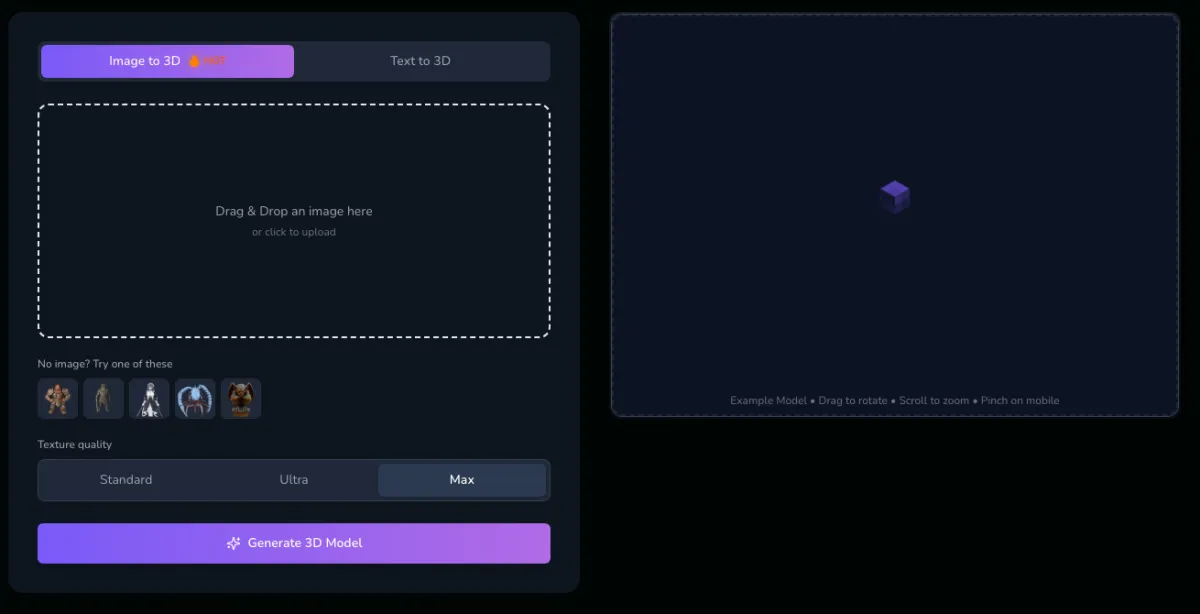
The hosted version on triposr.org takes a simpler approach to the same job: upload a photo, the background is removed automatically, and you choose a Standard, Ultra, or Max texture tier for a full PBR-textured GLB. That format opens directly in Blender, Unity, Unreal, and three.js. Every plan includes full PBR-textured output, so you are not paying for a higher plan just to unlock textures.
Hitem3D (Hi3D)
Strengths
- Geometry up to 2048 cubed on v3.0
- Portrait model line tuned for people
- Free retries per task, from 3 to 15 by plan
Watch-outs
- v3.0 Master costs 130 credits for geometry alone
Meshy
Strengths
- Up to 4K geometry resolution on Meshy 7.1
- 2K, 4K, or 8K textures
- Leads its own published detail benchmark
- Free retries on paid plans, from 4 to 40 per task
Watch-outs
- 4K geometry is not available for multi-image input
TripoSR
Strengths
- Full PBR-textured GLB on every hosted plan
- Standard, Ultra, or Max texture tier per generation
- Automatic background removal
Meshy AI Text to 3D vs Hitem3D Text to Image
Best here: MeshyMeshy AI generates 3D models directly from a text prompt, while Hitem3D gets there in two steps: it creates an image from your text, and then turns that image into a model. Meshy's API splits text-to-3D into a preview that creates the mesh for 20 credits on Meshy 7.1 and a refine step that adds textures for 10 credits, or 15 credits at 8K, so you can check the shape before you pay for the rest.
Hi3D's route gives you a look at the concept before you commit to 3D. Its pricing page lists text-to-image at 3 to 20 credits depending on the image model, including Nano Banana and GPT Image options, followed by the usual geometry and texture costs. Meshy's own comparison treats this as having no text-to-3D at all, which is fair for a direct prompt, though the Hi3D workflow still takes you from a sentence to a model.
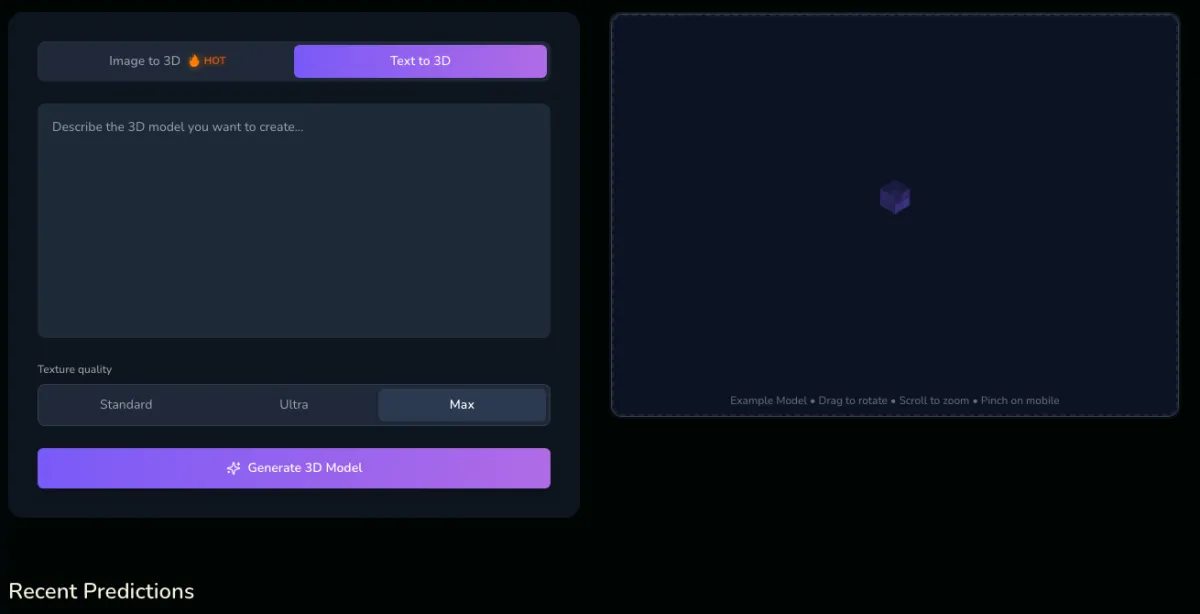
The hosted version on triposr.org also goes straight from a prompt to a PBR-textured GLB, and it is included on every plan and in the one-time credit packs. If your starting point is an idea and you only need a handful of models, that covers the same need with no monthly commitment. For a look at how text input compares across more tools, see our Meshy vs Rodin comparison.
Hitem3D (Hi3D)
Strengths
- Review a generated image before spending on 3D
- Choice of third-party image models
Watch-outs
- No direct text-to-3D; the image step costs extra credits
Meshy
Strengths
- Direct text-to-3D on every plan
- Separate preview and refine steps
Watch-outs
- Preview and refine are billed separately
TripoSR
Strengths
- Direct text-to-3D on every hosted plan
- Included in one-time credit packs
- PBR-textured GLB output
Hitem3D Pricing vs Meshy AI Pricing
Best here: TripoSRHitem3D pricing and Meshy AI pricing are almost identical at the entry level: Hi3D Pro lists at 19.90 USD a month and Meshy Pro at 20 USD a month, each with 1,000 credits and up to 100 models. Above that, Hi3D Max lists at 39.90 USD with 4,000 credits on its current promotion and Ultra at 99.90 USD with 10,000 credits, while Meshy Premium costs 40 USD for 3,000 credits and Ultra costs 100 USD for 8,000 credits.
Offers change the first bill on both. On 2026-11-02, Hi3D showed 50% off the first month, so Pro at 9.90 USD and then 19.90 USD on renewal, or 119.40 USD for the first year on an annual plan, and Meshy advertised new users 50% off the first month or 20% off an annual plan. Unused subscription credits do not roll over on either service, Meshy resets plan credits monthly and Hi3D refreshes them every 30 days, and neither promises refunds as a general rule. Both also let you buy extra credits, but Hi3D limits credit packs to subscribers.
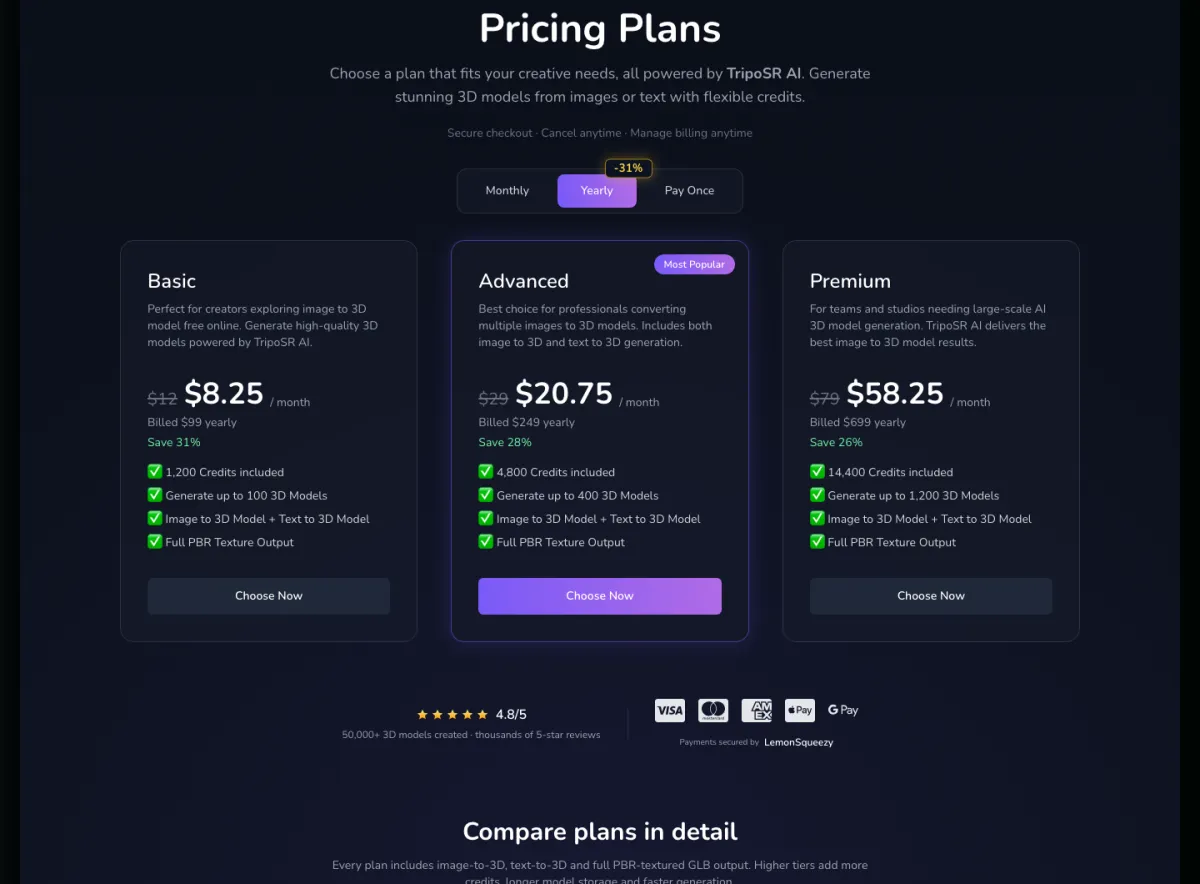
The hosted version on triposr.org is built so you can pay once. A one-time credit pack covers image-to-3D and text-to-3D with full PBR output and includes a commercial license, or you can pick a monthly or yearly plan if you generate often, and every plan includes watermark-free downloads and a commercial license. Meshy also sells extra credits on its Free plan, though the download cap and CC BY license of that plan remain. If your budget is zero, the open-source TripoSR model is free to download and run as often as you like.
| Plan | Hi3D (list price, credits) | Meshy (list price, credits) |
|---|---|---|
| Free | 0 USD, 100 credits once | 0 USD, 100 credits a month |
| Entry | Pro: 19.90 USD, 1,000 | Pro: 20 USD, 1,000 |
| Middle | Max: 39.90 USD, 4,000 | Premium: 40 USD, 3,000 |
| Top self-serve | Ultra: 99.90 USD, 10,000 | Ultra: 100 USD, 8,000 |
Monthly list prices read from each official pricing page on 2026-11-02. Hi3D's Max and Ultra credits reflect its promotion that day.
How Many Models Does Each Plan Make?
Hi3D and Meshy both describe their 1,000-credit Pro plan as up to 100 models, but the count depends on which model you pick. On Hi3D, geometry costs 10 credits on v2.1 Fast, 30 on v3.0 Quality, and 130 on v3.0 Master, and stylized texture adds 10 credits. Its own plan table shows up to 33 v3.0 Quality geometry models a month on Pro, or about 25 with stylized texture, so choosing the newest model reduces the count by two thirds or more.
On Meshy, the API price list shows 30 credits for a Meshy 7.1 image-to-3D model with 2K or 4K textures, 35 with 8K textures, and 5 more for Ultra geometry, while Meshy 6 Lite costs 15. By that list, 1,000 credits make about 33 textured Meshy 7.1 models, a third of the headline figure. On triposr.org, each texture tier uses a set number of credits, and you choose the tier for each model.
Hitem3D (Hi3D)
Strengths
- Pro lists 10 cents below Meshy Pro
- Failed generations return your credits
- More credits than Meshy on Max and Ultra during its promotion
- Purchased credit packs never expire
Watch-outs
- v3.0 Quality geometry fits about 33 models on Pro
- Credit packs are for subscribers only
Meshy
Strengths
- Same 1,000 credits on Pro
- New-user and annual offers
- Purchased credits do not expire
Watch-outs
- Plan credits reset monthly and do not accumulate
- Refunds are exceptions, not the rule
TripoSR
Strengths
- One-time credit packs, no subscription needed
- Same commercial rights on every plan
- Open model is free to run yourself
Watch-outs
- Each hosted generation uses credits; the Max texture tier uses the most
Is Meshy AI Free? Free Plans and Commercial Rights
Best here: MeshyMeshy AI has a free plan with 100 credits a month and no credit card, and its output is licensed under CC BY 4.0, which allows commercial use as long as you credit Meshy. The free plan limits downloads to 10 Meshy 6 Lite models a month, runs at low queue priority with one task at a time, and leaves out multi-view input and the API. It is a real way to try the product, and paid plans change the license to private and customer-owned.
Hitem3D's free plan is more of a trial. Hi3D gives 100 trial credits once rather than every month, and its plan card lists no 3D model downloads and no commercial use, with room to save up to 7 models. Commercial use starts with Pro. Hi3D's Terms of Use (version 1.5, September 15, 2026) say you own the outputs subject to your plan, and they also include a credit clause asking for "Created with Hi3D" or "Generated by Hi3D" when you share publicly or use work commercially, so read that clause if attribution matters to your project.
TripoSR has the cleanest answer on rights. The open-source TripoSR model is free under the MIT license, with no attribution requirement on what you make, though you need your own GPU or some patience on a CPU. The hosted version on triposr.org is a paid service that requires registration, and every plan includes a commercial license and watermark-free downloads. For a wider look at free routes, read our free Meshy alternative guide and our best free image-to-3D roundup.
| Free plan | Hi3D | Meshy |
|---|---|---|
| Credits | 100, once | 100 a month |
| Model downloads | None | 10 Meshy 6 Lite models a month |
| Commercial use | No | Yes, with credit (CC BY 4.0) |
| Credit card | Not listed | Not required |
Sources: Hi3D and Meshy pricing pages, read 2026-11-02.
Hitem3D (Hi3D)
Strengths
- 100 credits to try the workflow
- 3 free retries per task
Watch-outs
- No 3D model downloads on the free plan
- No commercial use on the free plan
- Credits do not renew
Meshy
Strengths
- 100 credits renew every month
- No credit card required
- Commercial use allowed with credit
Watch-outs
- Downloads limited to 10 Meshy 6 Lite models a month
- Low queue priority
TripoSR
Strengths
- Open model is free under MIT, with no attribution requirement
- Commercial license on every hosted plan
Hitem3D vs Meshy for 3D Printing
Best here: Hitem3D (Hi3D)Hitem3D and Meshy both treat 3D printing as a main use case, and Hitem3D goes furthest toward the finished object because it can arrange your model, send it to your slicer, or print and deliver it for you. Hi3D's home page lists smart arrangement, export to STL, OBJ, 3MF, GLB, and USDZ, slicer hand-off, and a print service where you pick a model, material, and size. Its pricing page adds Split to Print at 20 credits, Multi-color Print at 10 credits, and Relief at 10 credits.
Meshy has the deeper set of checks. Its API documents Analyze Printability, Repair Printability, Auto Split, and Multi-Color Print, and its comparison page claims one-click sending to 9 slicers on Pro and above, with a 97% slicer pass rate in Meshy's internal test. That number comes from Meshy itself, so treat it as a vendor figure, but having a documented repair step is useful if you print a lot and do not want to fix meshes by hand.
With TripoSR, you start from a textured GLB, which you can convert to STL and print after a quick pass through Blender or your slicer. If you plan to sell prints, the rights side is simple: every hosted plan includes a commercial license, and the open-source TripoSR model is plain MIT with no territory clause or user cap. For a one-off gift or a small batch of figures, a one-time credit pack is often all you need.
Hitem3D (Hi3D)
Strengths
- Print arrangement and slicer hand-off
- Print-and-deliver service
- Split, multicolor, and relief tools
- 3MF export
Watch-outs
- Print tools each use extra credits
Meshy
Strengths
- Printability analysis and repair
- Auto Split with optional connectors
- Slicer sending on Pro and above
Watch-outs
- The 97% pass rate is Meshy's internal figure
TripoSR
Strengths
- Commercial license on every hosted plan
- MIT open model with no territory clause
Watch-outs
- Hosted output is GLB, so STL takes one conversion step
Hitem3D API vs Meshy AI API
Best here: MeshyThe Hitem3D API and the Meshy AI API both turn images into textured models, and Meshy's covers far more of the pipeline while Hitem3D publishes a simpler USD price per model. Hi3D charges 0.02 USD per credit through its separate Open Platform, so a v2.1 Fast model with texture and PBR costs 0.50 USD, v3.0 Quality costs 0.90 USD, and v3.0 Master costs 2.90 USD. Its documented tools cover image and multi-view generation, relief, model split, multicolor, and embroidery.
Meshy's API uses prepaid credits that you buy in your subscription settings, and API access starts with the Pro plan. A Meshy 7.1 image-to-3D job with 2K textures costs 30 credits, and the endpoint list also covers text to 3D, retexture, remesh, UV unwrap, rigging, animation, text to motion, printability repair, and Auto Split. Webhooks and an MCP and skill option for AI agents are also on offer. If your app needs a rigged, animated character, this is the more complete API.
The open-source TripoSR model gives developers a different option: because it is MIT-licensed, you can serve it behind your own endpoint with no per-call fee, no vendor account, and no credit balance to watch. It reconstructs a mesh in under half a second on an A100, and it needs about 6 GB of VRAM, so it is cheap to host. Start with the download guide if you want to try it.
| Hi3D API | Meshy API | |
|---|---|---|
| Access | Open Platform, separate console | Pro plan and above |
| Billing | 0.02 USD per credit | Prepaid API credits |
| Current model cost | 45 credits (v3.0 Quality, textured, PBR) | 30 credits (7.1 with 2K textures) |
| Beyond generation | Relief, split, multicolor, embroidery | Rigging, animation, remesh, printability repair |
| Exports | OBJ, GLB, STL, FBX, USDZ, 3MF | GLB, OBJ, FBX, USDZ, STL, Blender |
Sources: Hi3D API docs; Meshy API pricing and pricing page, read 2026-11-02.
Hitem3D (Hi3D)
Strengths
- Published price of 0.02 USD per credit
- Print-focused split, multicolor, and relief endpoints
Watch-outs
- No rigging or animation endpoints
Meshy
Strengths
- Rigging, animation, remesh, and retexture endpoints
- Webhooks and a credit calculator
Watch-outs
- API access starts with a paid plan
TripoSR
Strengths
- MIT license lets you run the model behind your own API
- No API key, vendor account, or per-call fee when self-hosted
Watch-outs
- The hosted version is used through the triposr.org web app
Hitem3D Review and Meshy AI Reviews: What Users Report
User reviews put Meshy AI at 4.7 out of 5 from 4,371 reviews on G2 and Hi3D at 4.4 out of 5 from 30 reviews, as of 2026-11-02, so Meshy's score rests on a far larger sample. G2's review summary for Meshy lists ease of use, 3D modeling, and speed as the top positives, and 3D modeling issues, poor rendering quality, and inaccuracy as the top complaints. That pattern is common for AI 3D tools: the first result arrives quickly, and the remaining work is in the details.
Community discussion is more specific. In an r/StableDiffusion thread comparing 3D platforms, one commenter praised Sparc3D (Hitem3D) for organic subjects like monsters, rated its textures a bit below Hunyuan3D 2.5, and described using the 1536 setting for models of about 2 million triangles, then baking down to a low-poly model for games. Keep in mind that the thread is about a year old and predates both Hi3D v3.0 and Meshy 7.
Read these reviews with the same care as any vendor benchmark. Meshy also publishes its own comparison against Hi3D, so the most useful test is your own image. Before you start a subscription, try your hardest picture on a free plan where you can, and compare the result with the hosted version on triposr.org, where a small credit pack is enough to test your own pictures.
| G2, 2026-11-02 | Hi3D | Meshy |
|---|---|---|
| Rating | 4.4 out of 5 | 4.7 out of 5 |
| Reviews | 30 | 4,371 |
Source: G2 product pages for Hi3D and Meshy.
The Best Meshy AI and Hitem3D Alternative: TripoSR
TripoSR is the best Meshy AI and Hitem3D alternative for creators who want commercial, watermark-free 3D models without a subscription or a credit allowance that resets each month. Hi3D and Meshy are both strong products, and each is right for a specific job: Hi3D for detailed models headed to a printer, Meshy for characters that need rigging and animation. Most people generating 3D models want something simpler: a good textured model, the right to use it, and a price they only pay when they need it.
On triposr.org you upload a photo or type a prompt and get a PBR-textured GLB, with the background removed automatically, no watermark, and a commercial license on every plan. A one-time credit pack covers both image-to-3D and text-to-3D, and you can choose the Standard, Ultra, or Max texture tier for each model. A pack does not renew, so nothing gets billed again unless you choose to buy more.
Because the underlying open-source TripoSR model is MIT-licensed and small enough for a 6 GB GPU, you are never locked in: the same model family runs on your own hardware for free whenever you want it to, with no territory clause and no user cap. Neither Hi3D nor Meshy publishes weights you can run yourself, so this combination of a polished hosted version and a permissive open model is what sets TripoSR apart. If you came here looking for other options too, our Meshy alternative guide covers more of them.
Hitem3D or Meshy: Which Should You Choose?
You want textured 3D models now and then, without a subscription
TripoSR One-time credit packs with full PBR GLB output, image-to-3D and text-to-3D included.
You sell 3D assets or deliver models to clients
TripoSR Commercial license and watermark-free downloads on every hosted plan, with an MIT open model behind them.
You build a pipeline or app and want to run the model yourself
TripoSR MIT license, about 6 GB of VRAM, and sub-second reconstruction on an A100.
You want a detailed figure from one picture, printed and delivered
Hitem3D (Hi3D) Geometry up to 2048 cubed, print arrangement, slicer hand-off, and a print service.
You make game characters that need rigging and animation
Meshy Auto-rigging, 600+ preset motions, and plugins for Blender, Unity, and Unreal.
How We Compared Hitem3D and Meshy
We compared Hitem3D, Meshy, and TripoSR on the questions that decide which generator people pay for: image-to-3D quality, text input, plan pricing, free-plan rights, 3D printing, and API access.
Facts for each tool were read from its official pricing page, terms, API documentation, or changelog on 2026-11-02, and every claim carries a source listed below. Quality rounds weigh each vendor's published settings and benchmarks together with community reports, and we name the source whenever a figure comes from the vendor itself. Hi3D's prices were on promotion that day and these products update often, so check the current terms before you commit.
Our Recommendation
Hitem3D is the specialist for detailed models you plan to print, and Meshy is the specialist for assets that go on to rigging and animation. For everyone else, and that is most creators, TripoSR is the one to start with: commercial, watermark-free, PBR-textured models from a photo or a prompt in your browser, one-time credit packs with no subscription, and an MIT-licensed open model behind it that you can run yourself for free.
Hitem3D vs Meshy FAQ
Hitem3D vs Meshy: which is better?
It depends on what you do after generating the model. Hitem3D, now Hi3D, is the stronger pick for detailed models from a single image and for 3D printing, with arrangement, slicer hand-off, and a print service. Meshy is the stronger pick for text-to-3D, rigging, animation, and game engine plugins. Both list Pro at about 20 USD a month. If you want commercial, watermark-free models with no subscription, TripoSR on triposr.org is the simpler choice of the three, with one-time credit packs.
Is Hitem3D the same as Hi3D?
Yes. Hitem3D is the earlier name of Hi3D, the image-to-3D platform from Math Magic, and its Terms of Use refer to the service as hi3d.ai (hitem3d.ai). The plans and the underlying Sparc3D and Ultra3D models belong to the same product, and the API documentation sits at docs.hi3d.ai. You will still see the old name in plugin file names, older articles, and search results, so a guide that mentions Hitem3D is talking about Hi3D, though it may describe an older version than the current v3.0.
How much does Hitem3D cost?
Hitem3D, now Hi3D, lists Pro at 19.90 USD a month with 1,000 credits, Max at 39.90 USD, and Ultra at 99.90 USD, read on 2026-11-02. A promotion that day offered 50% off the first month, or the first year on an annual plan, which made Pro 119.40 USD for its first year. The free plan gives 100 credits once. On the API, Hi3D charges 0.02 USD per credit, so a textured v3.0 Quality model costs 0.90 USD. Check the official pricing page, since these offers change.
How much is Meshy AI?
Meshy AI costs 20 USD a month for Pro with 1,000 credits, 40 USD for Premium with 3,000 credits, and 100 USD for Ultra with 8,000 credits, with a Studio team plan at 70 USD and custom Enterprise pricing, as read on 2026-11-02. Meshy also advertises new users 50% off the first month or 20% off an annual plan. The Free plan costs nothing and includes 100 credits a month. Plan credits do not accumulate, though credits you purchase separately do not expire.
Is Meshy AI free?
Meshy AI has a free plan with 100 credits every month and no credit card required, but it comes with limits. Downloads are capped at 10 Meshy 6 Lite models a month, you run one task at a time at low queue priority, and outputs are licensed under CC BY 4.0, which allows commercial use as long as you credit Meshy. Paid plans remove the attribution requirement. For a fully free route with no attribution, the open-source TripoSR model is MIT-licensed and runs on your own GPU.
Is Hitem3D free?
Hitem3D, now Hi3D, has a free plan, but it works as a trial. You get 100 credits once rather than every month, enough for up to 10 v2.1 geometry models or 3 v3.0 Quality models, and you can save up to 7 models. The plan card says no 3D model downloads and no commercial use, so you need Pro or above to download and use your work commercially. The same card lists 3 free retries per task, which helps when a first result misses.
Is Meshy AI safe?
Meshy AI is an established commercial service, and Meshy states that it holds SOC 2 Type II and ISO 27001 certifications. Payments go through Stripe, so Meshy says it never sees your card data, and it has 4,371 reviews on G2 averaging 4.7 out of 5 as of 2026-11-02. As with any hosted AI tool, read the terms before you upload private images or client work, and remember that free-plan output is CC BY 4.0, while paid plans make assets private and customer-owned.
Who owns the 3D models I generate?
It depends on the service and the plan. Meshy says you own what you create on a paid plan, while free-plan output is under CC BY 4.0. Hi3D's Terms of Use say you own your outputs subject to your plan, its free plan card says no commercial use, and its terms ask for credit such as "Created with Hi3D" when you share publicly or use work commercially. Every plan on triposr.org includes a commercial license, and the open-source TripoSR model is MIT-licensed. Each service leaves it to you to clear rights in your input image.
Does Hitem3D have an API?
Yes. Hitem3D, now Hi3D, offers an API through its Open Platform at platform.hi3d.ai, with documentation at docs.hi3d.ai. It covers single-image and multi-view generation, relief, model split, multicolor, and embroidery, and it exports OBJ, GLB, STL, FBX, USDZ, and 3MF for image-to-3D. Credits cost 0.02 USD each, and a textured model ranges from 0.30 USD on the oldest v1.5 setting to 2.90 USD on v3.0 Master. It has no rigging or animation endpoints, which are Meshy's area.
Is Hitem3D open source?
No. Hitem3D, now Hi3D, is a commercial hosted service, and its Sparc3D and Ultra3D models are not available as open weights. The Sparc3D paper is public on arXiv (2505.14521), and a GitHub repository under that name exists, but on 2026-11-02 it held only a README, a project assets folder, and a citation, with no model code or weights. If you want a model you can download and run commercially, the open-source TripoSR model is MIT-licensed and needs about 6 GB of VRAM.
Which is better for 3D printing, Hitem3D or Meshy?
Hitem3D, now Hi3D, is the better pick if you want the shortest path to a physical object, since it arranges your model, sends it to your slicer, splits parts for printing, handles multicolor, and offers a print-and-deliver service. Meshy has the deeper set of printability tools, with analysis and repair endpoints and a claimed 97% slicer pass rate from its own internal test. Both export STL and 3MF. For occasional prints, TripoSR on triposr.org gives you a GLB you can convert to STL, with commercial rights included.
What is the best Meshy AI alternative?
TripoSR is the best Meshy AI alternative for people who want textured 3D models without a subscription. The hosted version on triposr.org creates a PBR-textured GLB from a photo or a prompt, with one-time credit packs, watermark-free downloads, and a commercial license on every plan, and the open-source model is free under MIT on your own GPU. Hitem3D, now Hi3D, is a good alternative if your main goal is detailed models for 3D printing. If you need rigging and animation built in, Meshy itself remains hard to replace.
Sources and References
- Hi3D (Hitem3D) official pricing page (accessed 2026-11-02)
- Hi3D (Hitem3D) official home page (accessed 2026-11-02)
- Hi3D Terms of Use, version 1.5 (accessed 2026-11-02)
- Hi3D API documentation: introduction (accessed 2026-11-02)
- Hi3D API documentation: pricing (accessed 2026-11-02)
- Hi3D API Open Platform (accessed 2026-11-02)
- Sparc3D paper (arXiv 2505.14521) (accessed 2026-11-02)
- Sparc3D GitHub repository (accessed 2026-11-02)
- Sparc3D Hugging Face Space (accessed 2026-11-02)
- Meshy official pricing page and FAQ (accessed 2026-11-02)
- Meshy comparison page: Meshy vs Hi3D (accessed 2026-11-02)
- Meshy API documentation: pricing (accessed 2026-11-02)
- Meshy API changelog (accessed 2026-11-02)
- G2: Hi3D reviews (accessed 2026-11-02)
- G2: Meshy reviews (accessed 2026-11-02)
- Reddit r/StableDiffusion: GenAI 3D asset platforms compared (accessed 2026-11-02)
- triposr.org pricing and plan comparison (accessed 2026-11-02)
- TripoSR official GitHub repo (accessed 2026-11-02)
- TripoSR paper (arXiv 2403.02151) (accessed 2026-11-02)
- TripoSR Hugging Face model card (accessed 2026-11-02)
More AI 3D Generator Comparisons
TripoSR Team
Editorial, triposr.org
The triposr.org team compares image-to-3D and text-to-3D tools from their official pricing pages, documentation, model cards, and licenses, and checks every figure against a dated source.
Make a commercial-ready 3D model in your browser
Upload a photo or type a prompt and get a PBR-textured GLB in your browser, no GPU required. Every plan includes watermark-free downloads and a commercial license.
Try TripoSR image to 3D