Rodin vs Hunyuan3D vs TripoSR: Which AI 3D Generator Is Worth It in 2026?
Rodin and Hunyuan3D are the two big names in AI 3D generation. Here is how they compare on price, license, quality, inputs, API, and local setup, and why TripoSR is the easiest pick for most creators.
 By TripoSR TeamUpdated 2026-10-08Last tested 2026-10-08
The detail specialist: dense, watertight meshes and the widest export list, on a monthly plan.
Best for Highest mesh detail
Tencent's heavyweight: the most input types on its hosted engine, and open 2.1 weights for big GPUs.
Best for Most input types and pay-as-you-go API
The clean-license pick: commercial, watermark-free PBR models in your browser, or the free MIT model on your own GPU.
Best for Clean commercial rights
Visit TripoSRRodin vs Hunyuan3D comes down to one trade: Rodin, from Deemos under the Hyper3D brand, makes the densest, most production-ready meshes on a paid monthly plan, while Hunyuan3D, from Tencent, gives you the most input types on its hosted 3.0 engine and open 2.1 weights you can run yourself, under a license with territory limits. If you want commercial, watermark-free 3D models without a license review or a GPU, with one-time credit packs available when you would rather not subscribe, TripoSR is the easiest choice of the three.
This guide lines up all three generators on the questions people actually ask before they commit: who owns the model you make, how good the mesh and textures look, what you can feed in, what it costs, how the APIs work, and whether you can run it on your own hardware. One of the three is the open-source TripoSR model, also available as a hosted version on triposr.org, and every number below carries a source you can check at the end of the page.
Competitor facts come from each vendor's own pricing, feature, documentation, license, and announcement pages, read on 2026-10-08. Rodin, Hyper3D, and Hunyuan3D are trademarks of their owners; this is an independent comparison, not a sponsorship.
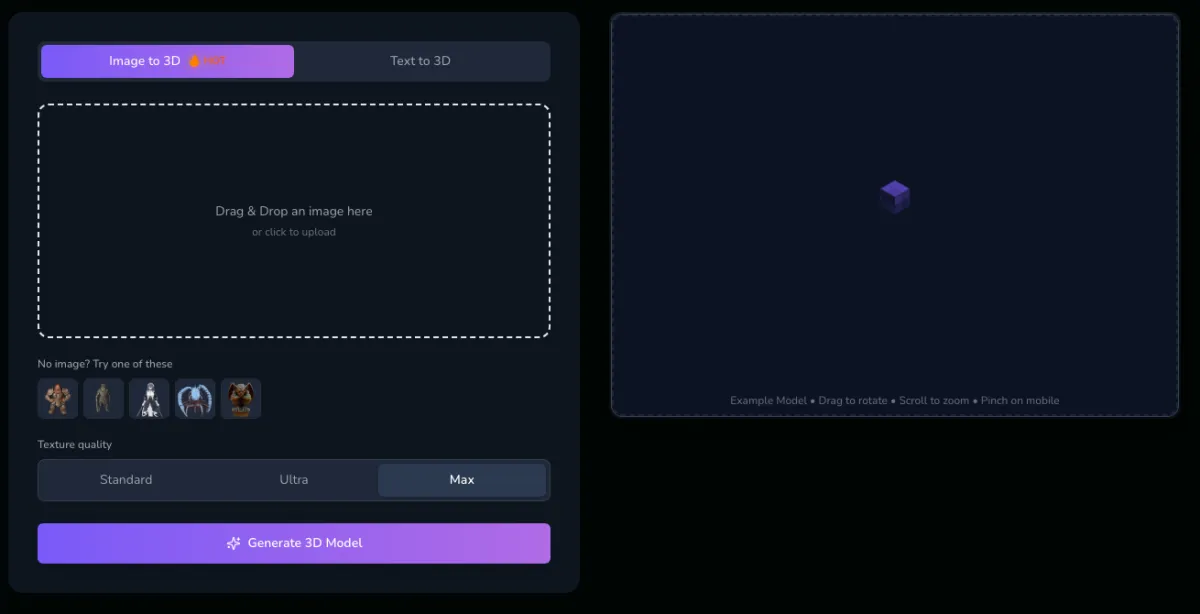
Rodin
Hyper3D Rodin Gen-2.5 by Deemos
- Runs
- Browser, API, plug-ins
- Cheapest paid plan
- 30 USD a month
- Commercial use
- Paid plans
- Open weights
- No
Strong at
- Watertight meshes up to 10M polygons
- Eight export formats, STL to USDZ
Catch
- API access starts with the 120 USD Business plan
Hunyuan3D
Tencent: hosted engine and open 2.1 weights
- Runs
- Web, Tencent Cloud API, local
- Free tier
- 20 generations a day
- Commercial use
- Community license
- Open weights
- 2.1, about 29 GB VRAM
Strong at
- Text, image, sketch, and up to 4 views
- Pay-as-you-go API with 200 free credits
Catch
- Open 2.1 license excludes the EU, UK, and South Korea
Hosted on triposr.org, open model under MIT
- Runs
- Browser, or your own GPU
- Pricing
- One-time packs or plans
- Commercial use
- Every plan
- Open weights
- MIT, about 6 GB VRAM
Strong at
- PBR-textured GLB from a photo or a prompt
- Watermark-free downloads and commercial license on every plan
- One-time credit packs, no subscription needed
- Open model runs in under 0.5 s on an A100
| Commercial rights | Paid plans | Community license; EU, UK, KR excluded on open weights | BestEvery hosted plan; open model is MIT |
|---|---|---|---|
| Output | BestWatertight high-poly mesh, PBR, 8 formats | PBR textured mesh, OBJ and GLB | Full PBR textured GLB (hosted) |
| Inputs | Image, multi-image (limited on free), text | BestText, image, up to 4 views, sketch | Image or text (hosted) |
| How you pay | From 30 USD a month, or 1.5 USD per credit | 20 free a day on the web, API credits | BestOne-time packs or monthly plans |
| API | Business plan, from 96 USD a month | BestTencent Cloud, 200 free credits | Self-host the MIT model, no per-call fee |
| Run it yourself | Not available | 2.1 weights, about 29 GB VRAM | BestMIT, about 6 GB VRAM |
Rodin Creator is its cheapest paid plan. Hunyuan3D web use is free up to 20 generations a day. TripoSR sells one-time credit packs with no monthly plan required.
Counted from each license: territory exclusions and user-count clauses. Rodin publishes no open model.
Want to make your own? Try the Image to 3D model generator, Text to 3D model generator, Meshy vs rodin vs triposr, Hunyuan3d versions or Hunyuan3d vs trellis.
What Is Rodin AI (Hyper3D Rodin Gen-2.5)?
Rodin AI is a commercial 3D generator from Deemos, sold under the Hyper3D brand, that turns images or text into high-detail, watertight 3D meshes in the browser. Its current model, Gen-2.5, returns base geometry in about four seconds and a full textured model in about five, according to the Hyper3D image-to-3D feature page, and it targets meshes of up to 10 million polygons with optional levels of detail.
Rodin's output is built for production pipelines. The feature page describes the meshes as solid, manifold, and watertight, with albedo, roughness, and metalness maps, and the export list is the longest of any tool in this comparison: GLB, FBX, OBJ, STL, USDZ, glTF, 3MF, and DXF. Hyper3D also lists plug-ins for Blender, Unity, Unreal, Godot, Maya, 3ds Max, and ComfyUI, and its Blender add-on documentation asks for Blender 4.0 or newer.
Pricing follows a pay-by-result model. The free plan lets you generate before you confirm, exports legacy models only, and keeps ten private assets; Creator costs 30 USD a month (24 USD billed yearly) and Business costs 120 USD a month (96 USD billed yearly) with full API access. Credits can also be bought directly at 1.5 USD each.
| Rodin Gen-2.5 | Detail |
|---|---|
| Maker | Deemos, sold as Hyper3D |
| Speed | About 4 s geometry, about 5 s textured |
| Mesh | Watertight, up to 10M polygons, optional LOD |
| Textures | Albedo, roughness, metalness |
| Exports | GLB, FBX, OBJ, STL, USDZ, glTF, 3MF, DXF |
| Paid plans | Creator 30 USD/mo, Business 120 USD/mo |
Source: Hyper3D pricing and image-to-3D feature pages, read 2026-10-08.
Is Hyper3D the Same as Rodin?
Hyper3D and Rodin are the same product: Hyper3D is the brand and website (hyper3d.ai) run by Deemos, and Rodin is the name of the 3D generation model and app sold there. When people search for "Hyper3D Rodin", "Rodin AI", or "Deemos Rodin", they all land on the same generator and the same pricing page.
The naming matters mostly when you look for documentation. The API reference lives at docs.hyper3d.ai, the API key is created in the Hyper3D workspace dashboard, and the Blender add-on documentation sits on Deemos's own docs site. All of them describe the same Rodin Gen-2.5 model.
What Is Hunyuan3D? Open 2.1 Weights vs the Hosted 3.0 Engine
Hunyuan3D is Tencent's family of 3D generation models, and it comes in two forms: Hunyuan3D 2.1 with open weights you can download, and Tencent's hosted Hunyuan 3D engine on its web platform and Tencent Cloud API, which offers model versions 3.0 and 3.1. The two are easy to confuse, and they behave very differently in practice.
Hunyuan3D 2.1 was released in June 2025 (June 13, per its README and license) as two models: a 3.3B-parameter shape model and a 2B-parameter paint model for PBR textures. Its README says it supports macOS, Windows, and Linux, was tested with Python 3.10 and PyTorch 2.5.1 with CUDA 12.4, and needs about 10 GB of VRAM for shape generation, 21 GB for textures, and 29 GB for both. It ships under the Tencent Hunyuan Community License.
Tencent launched the hosted Hunyuan 3D engine globally on 2025-11-26, and its Tencent Cloud API lists model versions 3.0 and 3.1. The announcement promises 20 free generations a day for web users and 200 free credits for enterprise API users, with text, image, up to four multi-view images, and sketch as inputs, and export to mainstream formats such as OBJ and GLB. For every version Tencent has shipped, from 2.0 to 3.1 and PolyGen, see our Hunyuan3D versions guide.
| Hunyuan3D 2.1 | Hosted engine (3.0, 3.1) | |
|---|---|---|
| How you use it | Download and run | Web platform or Tencent Cloud API |
| Inputs | Image | Text, image, up to 4 views, sketch |
| Hardware | About 29 GB VRAM for shape plus texture | None (hosted) |
| Cost | Free under the community license | 20 free a day on the web; API credits |
Sources: Hunyuan3D-2.1 README and Tencent global launch announcement, read 2026-10-08.
Rodin vs Hunyuan3D Commercial License: Who Owns Your Model?
Best here: TripoSRRodin vs Hunyuan3D on licensing is a choice between a paid plan and a regional license: Rodin reserves commercial licensing for its paid plans, while Hunyuan3D's open 2.1 weights come with a community license that does not apply in the EU, the UK, or South Korea. Rodin's feature page says paid plans add commercial licensing, and its pricing page describes paid plans as including broader export and usage rights.
The Tencent Hunyuan Community License for 2.1 states that it does not apply in the European Union, the United Kingdom, or South Korea, and requires companies whose products had more than 1 million monthly active users when 2.1 was released to request a separate license from Tencent. For a studio in Berlin or London, that is a real stop sign before a single model is generated, and the hosted 3.0 engine runs under Tencent's own platform terms instead.
TripoSR is the simplest answer here. Every hosted plan on triposr.org includes a commercial license and watermark-free downloads, so the model you generate is ready to sell, put in a game, or deliver to a client the moment you download it. And the open-source TripoSR model is plain MIT: no territory clause, no user cap, and no attribution requirement on what you make with it.
Rodin
Strengths
- Paid plans add commercial licensing and unlimited export
- No watermark mentioned on its official pages
Watch-outs
- Free plan exports legacy models only, with ten private assets
- Commercial use requires a paid plan
Hunyuan3D
Strengths
- Open 2.1 weights you can download and run
- Free daily generations on the hosted engine
Watch-outs
- Community license does not apply in the EU, UK, or South Korea
- Services above 1M monthly active users need a separate license
TripoSR
Strengths
- Commercial license on every hosted plan
- Watermark-free downloads
- Open model is plain MIT with no territory clause or user cap
Model Quality and Export Formats
Best here: RodinAll three generators produce PBR-textured 3D models; Rodin pushes geometric detail and export breadth furthest, Hunyuan3D separates shape and texture into two dedicated models, and the hosted TripoSR version delivers a PBR-textured GLB with selectable texture tiers. Rodin Gen-2.5 targets up to 10 million polygons with watertight, manifold geometry and albedo, roughness, and metalness maps, and exports GLB, FBX, OBJ, STL, USDZ, glTF, 3MF, and DXF.
Hunyuan3D builds each model in two stages, a shape model followed by a PBR paint model, and the 2.1 README calls the texture pipeline physics-grounded. The hosted engine exports mainstream formats such as OBJ and GLB, which covers most game engines and DCC tools.
The hosted version on triposr.org outputs a full PBR-textured GLB, the format that opens directly in Blender, Unity, Unreal, three.js, and AR viewers, and lets you choose a Standard, Ultra, or Max texture tier for each generation. Background removal runs automatically, so a product photo goes in as is and a clean, textured model comes out.
Rodin
Strengths
- Dense, watertight high-poly meshes up to 10M polygons
- Eight export formats including STL, USDZ, and 3MF
Watch-outs
- Full multi-image input, HD textures, and unlimited export are on paid plans
Hunyuan3D
Strengths
- Separate shape and PBR paint models
- Mainstream formats such as OBJ and GLB from the hosted engine
Watch-outs
- Full open pipeline needs about 29 GB of VRAM for textured output
TripoSR
Strengths
- Full PBR-textured GLB on every hosted plan
- Standard, Ultra, or Max texture tier per generation
- Automatic background removal
Text, Image, Sketch, and Multi-View Inputs
Best here: Hunyuan3DHunyuan3D's hosted engine accepts the widest range of inputs of the three: text, a single image, up to four multi-view images, or a sketch, according to Tencent's global launch announcement. That makes it the most flexible starting point when you have a concept drawing or several photos of the same object.
Rodin covers image-to-3D and text-to-3D on its free plan, includes limited multi-image input there, and opens up full multi-image input on its paid Creator plan. The open Hunyuan3D 2.1 weights, by contrast, take an image as input, so the extra input types belong to the hosted engine.
The hosted version on triposr.org covers the two inputs most people actually start from: one photo or a text prompt. Both run on every plan, so you can go from an idea to a textured model without first making a reference image, and the open-source TripoSR model is a single-image reconstructor, which is exactly what makes it so fast.
Rodin
Strengths
- Image-to-3D and text-to-3D on the free plan
- Multi-image input, limited on free and full on paid plans
Watch-outs
- Full multi-image input requires the Creator plan or above
Hunyuan3D
Strengths
- Text, image, up to four views, and sketch input on the hosted engine
Watch-outs
- The open 2.1 weights take image input only
TripoSR
Strengths
- Image-to-3D and text-to-3D on every hosted plan
- Open model reconstructs from a single photo
Watch-outs
- Each generation starts from one photo or one prompt
Rodin AI Pricing vs Hunyuan3D Free Generations
Best here: TripoSRRodin AI costs 30 USD a month for its cheapest paid plan, Creator (24 USD a month billed yearly, about 60 models by Rodin's estimate), while Hunyuan3D gives web users 20 free generations a day and enterprise API users 200 free credits. Rodin's Business plan costs 120 USD a month (96 USD billed yearly), and credits can also be bought directly at 1.5 USD each; its pay-by-result model lets you generate before you confirm, so you only spend a credit on a result you keep.
Hunyuan3D's paid path runs through Tencent Cloud. The billing documentation lists 200 free credits per user valid for one year, postpaid billing at 0.02 USD per credit that you switch on yourself, and prepaid packs from 1,000 credits for 15 USD up to 100,000 credits for 1,350 USD. A Pro generation costs 25 credits, about 0.50 USD, and failed tasks are not charged.
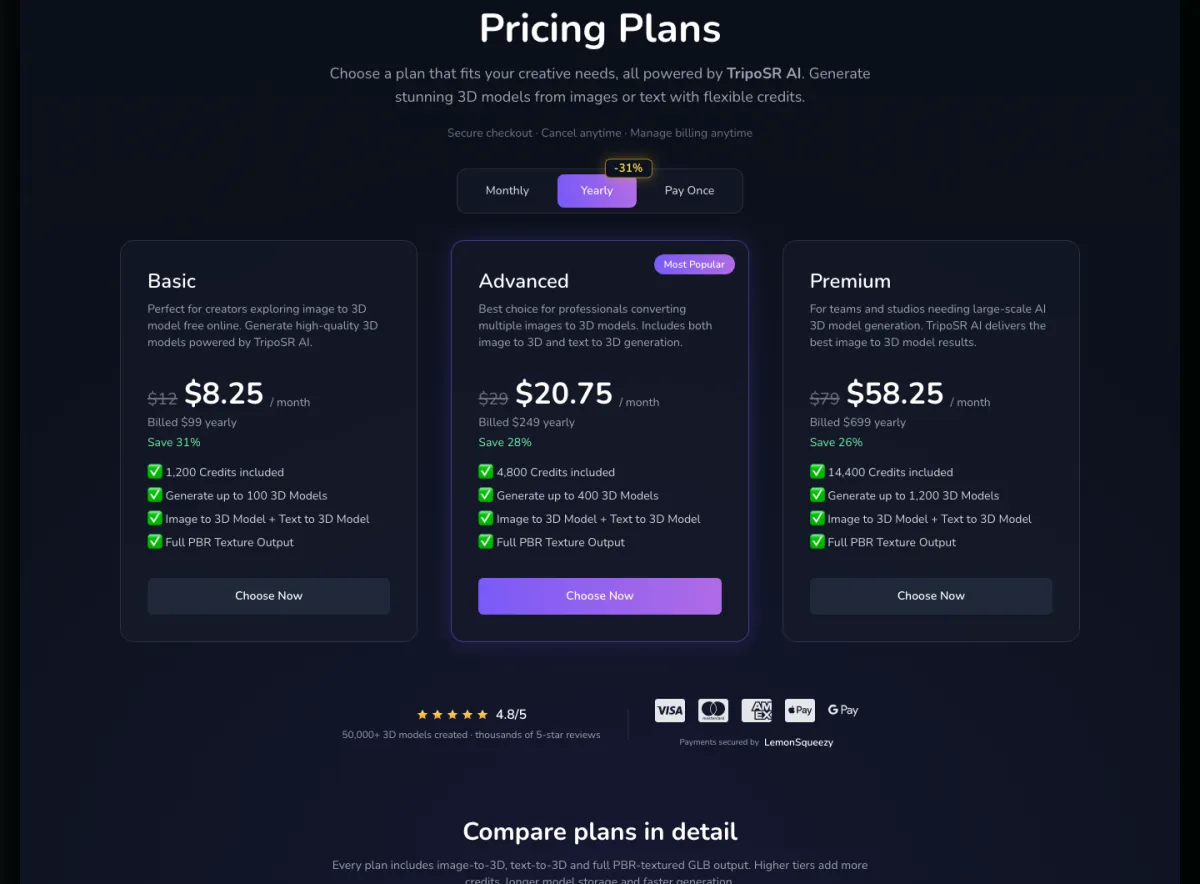
The hosted version on triposr.org keeps it simple. You can buy a one-time credit pack with no subscription, which covers image-to-3D and text-to-3D with full PBR texture output, or pick a monthly or yearly plan if you generate often. Every plan, from Basic to Premium, includes the same full PBR textures, watermark-free downloads, and commercial license; bigger plans add credits, longer storage, and faster generation. And if your budget is zero, the open-source TripoSR model is free to download and run as many times as you like.
Rodin
Strengths
- Pay by result: generate before you spend a credit
- Yearly billing cuts Creator to 24 USD a month
Watch-outs
- Commercial work starts at 30 USD a month (Creator)
- Direct credits are 1.5 USD each
Hunyuan3D
Strengths
- 20 free generations a day on the web
- 200 free API credits, valid for a year
Watch-outs
- Pro API jobs cost 25 credits, plus 10 for each add-on
TripoSR
Strengths
- One-time credit packs, no subscription needed
- Same PBR output and commercial rights on every plan
- Open model is free to run yourself
Watch-outs
- Each hosted generation uses credits; the Max texture tier uses the most
Hyper3D Rodin API vs Hunyuan3D API
Best here: Hunyuan3DThe Hyper3D Rodin API is included with Rodin's Business plan (120 USD a month, or 96 USD billed yearly), while the Hunyuan3D API runs on Tencent Cloud with 200 free credits and pay-as-you-go billing at 0.02 USD per credit. Rodin's pricing page lists full API access only on Business and custom API access on Enterprise; the Free and Creator plans do not include it.
Rodin's API charges per credit: the Gen-2.5 specification says a base generation costs 0.5 credits, with 0.5 more for the Extreme-High model and 2.0 more for extreme-high textures. Business includes 208 credits a month, which Rodin estimates at about 416 models. Requests authenticate with a bearer token, which you create in the Hyper3D API dashboard.
Hunyuan3D's API, now branded Tencent HY 3D Global, is asynchronous: you submit a job, receive a JobId, and poll until the status is DONE. Getting credentials takes a Tencent Cloud account with real-name verification, activating the service in the console, and creating a SecretId and SecretKey pair. If you would rather skip API keys entirely, the open-source TripoSR model is MIT-licensed, so you can serve it behind your own endpoint with no per-call fee and no vendor account.
| Hyper3D Rodin API | Hunyuan3D API (Tencent Cloud) | |
|---|---|---|
| Access | Business plan or Enterprise | Tencent Cloud account |
| Free allowance | Not stated | 200 credits, valid 1 year |
| Cost per job | 0.5 credits per base generation | 25 credits per Pro job, 15 per Express job |
| Credentials | API key from the API dashboard | SecretId and SecretKey from CAM |
| Workflow | Bearer token requests | Submit job, poll until DONE |
Sources: Hyper3D pricing and API docs; Tencent Cloud quick start and billing docs, read 2026-10-08.
How to Get a Hyper3D API Key
To get a Hyper3D API key, subscribe to a plan with API access (Business, or Enterprise), open the API dashboard in your Hyper3D workspace, and create a key there. The Hyper3D quick start then recommends storing it in an environment variable such as RODIN_API_KEY and sending it as a bearer token in the Authorization header of each request.
Treat the key like a password: keep it out of client-side code and version control. The API reference at docs.hyper3d.ai covers the Gen-2.5 endpoint, its parameters, and the credit cost of each option.
Rodin
Strengths
- 0.5 credits per base generation
- Simple bearer-token authentication
Watch-outs
- API access starts with the Business plan
Hunyuan3D
Strengths
- 200 free credits to start
- Pay-as-you-go at 0.02 USD per credit
Watch-outs
- Account setup needs real-name verification and a SecretId/SecretKey pair
TripoSR
Strengths
- MIT license lets you run the model behind your own API
- No API key, vendor account, or per-call fee when self-hosted
Watch-outs
- The hosted version is used through the triposr.org web app
Running Hunyuan3D 2.1 Locally: VRAM and Setup
Best here: TripoSRRunning Hunyuan3D 2.1 locally takes about 10 GB of VRAM for shape generation, 21 GB for texturing, and 29 GB for the full shape plus texture pipeline, according to its README, which also offers a low-VRAM mode. The README lists macOS, Windows, and Linux support and was tested with Python 3.10 and PyTorch 2.5.1 with CUDA 12.4; the model card lives on Hugging Face at tencent/Hunyuan3D-2.1.
For ComfyUI users, one community route is the node ComfyUI-Hunyuan3d-2-1 by visualbruno, listed first in the official README's community contribution leaderboard. ComfyUI's own documentation describes native support for the earlier Hunyuan3D-2mv model, without texture and material generation, so the textured 2.1 pipeline in ComfyUI runs through the community node. Rodin, for its part, is a closed hosted service with no weights to download.
The open-source TripoSR model is the lightest of the three by a wide margin. It reconstructs a mesh from one image in under half a second on an NVIDIA A100, needs about 6 GB of VRAM, falls back to CPU, and is MIT-licensed, so it runs on a mid-range gaming laptop, inside a pipeline, or at batch scale on cloud GPUs with no license strings. If you want the polished, textured result without any setup, the hosted version on triposr.org runs it for you in the browser.
Hunyuan3D 2.1 figure is the full shape plus texture pipeline (10 GB shape only). Rodin has no downloadable weights.
Rodin
Strengths
- Nothing to install: runs on Rodin's servers
- Plug-ins for Blender, Unity, Unreal, and more
Watch-outs
- No downloadable weights, so no local or offline use
Hunyuan3D
Strengths
- Open 2.1 weights on macOS, Windows, and Linux
- Community ComfyUI node for the 2.1 pipeline
Watch-outs
- About 29 GB of VRAM for the full textured pipeline
- Community license limits apply to self-hosting
TripoSR
Strengths
- About 6 GB of VRAM with CPU fallback
- Under 0.5 seconds per mesh on an A100
- MIT license, free and unlimited
Watch-outs
- Self-hosting means your own setup; the hosted version skips it
The Best Rodin and Hunyuan3D Alternative: TripoSR
TripoSR is the best Rodin and Hunyuan3D alternative for creators who want commercial, watermark-free 3D models without a regional license or a GPU, and without being tied to a subscription. Rodin and Hunyuan3D are both impressive, and each is the right tool for a specific job: Rodin for maximum mesh density, Hunyuan3D for sketch and multi-view input. But most people generating 3D models want the same three things: a good textured model, the right to use it commercially, and a price that does not lock them into a subscription.
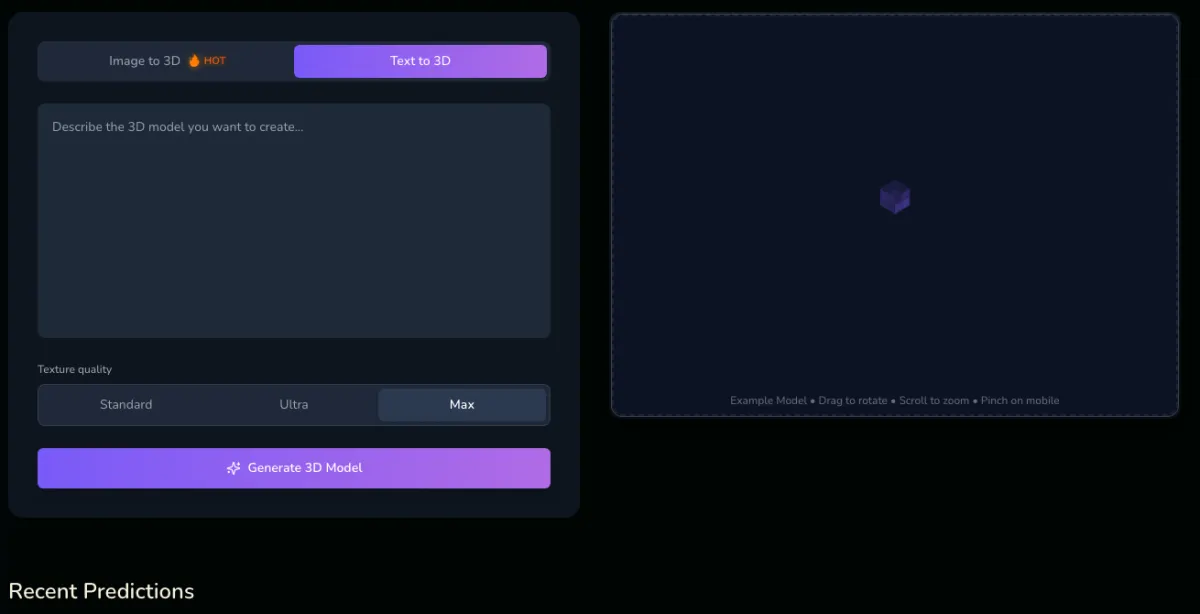
On triposr.org you upload a photo or type a prompt and get a PBR-textured GLB, with the background removed automatically, no watermark, and a commercial license included on every plan. If you only need a few models, a one-time credit pack covers image-to-3D and text-to-3D with no subscription, and you can choose the Standard, Ultra, or Max texture tier for each model.
Because the underlying open-source TripoSR model is MIT-licensed and small enough for a 6 GB GPU, you are never locked in: the same model family runs on your own hardware for free whenever you want it to, with no territory clause and no user cap. That combination of a polished hosted version and a permissive open model is what neither Rodin nor Hunyuan3D offers in one place.
Rodin or Hunyuan3D: Which Should You Choose?
You sell 3D assets or deliver models to clients
TripoSR Commercial license and watermark-free downloads on every hosted plan, with no territory clause on the open model.
You want textured 3D models from photos or prompts without a subscription
TripoSR One-time credit packs with full PBR GLB output, image-to-3D and text-to-3D included.
You build a pipeline or app and want to run the model yourself
TripoSR MIT license, about 6 GB of VRAM, and sub-second reconstruction on an A100.
You need the densest possible hero mesh and pay monthly anyway
Rodin Gen-2.5 targets up to 10M polygons with watertight geometry and eight export formats.
You start from sketches or several photos of one object
Hunyuan3D The hosted engine takes sketches and up to four multi-view images.
How We Compared Rodin and Hunyuan3D
We compared Rodin, Hunyuan3D, and TripoSR on the questions that decide which generator people stick with: commercial rights, output quality and formats, supported inputs, pricing, API access, and the option to run the model yourself.
Facts for each tool were read from its official pricing page, feature page, API documentation, license file, README, or announcement on 2026-10-08, and every claim carries a source listed below. Where a vendor does not publish a figure (for example, Rodin's free credit quota), we leave it out rather than repeat an unofficial number. These products update often, so check the current terms before you commit.
Our Recommendation
Rodin is the detail specialist and Hunyuan3D is the input-flexibility specialist. For everyone else, and that is most creators, TripoSR is the one to start with: commercial, watermark-free, PBR-textured models from a photo or a prompt in your browser, simple pricing with one-time packs or plans, and an MIT-licensed open model behind it that you can run yourself for free.
Rodin vs Hunyuan3D FAQ
Rodin vs Hunyuan3D: which is better?
It depends on what you start from and what you need out. Rodin Gen-2.5 makes the most detailed meshes, with watertight geometry up to about 10 million polygons, PBR maps, and eight export formats, and it needs a paid plan from 30 USD a month for commercial work. Hunyuan3D's hosted engine accepts the most input types (text, an image, up to four views, or a sketch) with 20 free generations a day. If you want commercial, watermark-free models with simple pricing and no license review, TripoSR on triposr.org is the simpler choice of the three.
Can I use Hunyuan3D 2.1 in ComfyUI?
Yes, through the community node ComfyUI-Hunyuan3d-2-1 by visualbruno, listed first in the official Hunyuan3D-2.1 README's community contribution leaderboard. ComfyUI's own documentation describes native support for the earlier Hunyuan3D-2mv model without texture and material generation, so the full textured 2.1 pipeline runs through the community node. Plan for about 29 GB of VRAM for shape plus texture, or about 10 GB for shape only. For a lighter ComfyUI-free route, the open-source TripoSR model runs in about 6 GB.
Is Rodin AI free?
Rodin has a free plan, but it is limited. You can generate before you confirm a result, then the free plan exports legacy models only and keeps ten private assets; Hyper3D does not publish a fixed number of free credits. Commercial licensing, unlimited export, and full multi-image input come with paid plans, starting with Creator at 30 USD a month (24 USD billed yearly). triposr.org also sells one-time credit packs with no subscription, and every triposr.org plan includes a commercial license.
How much does Rodin AI cost?
Rodin's cheapest paid plan, Creator, costs 30 USD a month, or 24 USD a month billed yearly (288 USD a year), which Rodin estimates at about 60 models and which expands multi-image input and adds HD textures, unlimited export, and unlimited private assets. Business costs 120 USD a month (96 USD billed yearly) and adds full API access, and Enterprise is custom. Credits can also be bought directly at 1.5 USD each.
How do I get a Hyper3D API key?
Subscribe to a Hyper3D plan with API access, which on the pricing page means Business (120 USD a month, or 96 USD billed yearly) or Enterprise, then create a key in the API dashboard of your Hyper3D workspace. The official quick start recommends storing it in an environment variable such as RODIN_API_KEY and sending it as a bearer token. A base Gen-2.5 generation costs 0.5 credits through the API, and Business includes 208 credits a month.
Is Hunyuan3D open source?
Partly. Hunyuan3D 2.1 has open weights and code on GitHub and Hugging Face under the Tencent Hunyuan Community License, which is a source-available license with conditions rather than an OSI open-source license: it does not apply in the EU, the UK, or South Korea and requires a separate license for companies whose products had more than 1 million monthly active users when 2.1 was released. The hosted engine (3.0 and 3.1) is offered through Tencent's platform and API. TripoSR, by comparison, is plain MIT.
Is Hunyuan3D free for commercial use?
Partly. The open Hunyuan3D 2.1 weights are free to download under the Tencent Hunyuan Community License, but that license states it does not apply in the European Union, the United Kingdom, or South Korea, and companies whose products had more than 1 million monthly active users when 2.1 was released must request a separate license from Tencent. The hosted engine gives 20 free generations a day under Tencent's platform terms. If you need a license with no territory or user limits, the open-source TripoSR model is plain MIT.
How much VRAM does Hunyuan3D 2.1 need?
Hunyuan3D 2.1 needs about 10 GB of VRAM for shape generation, about 21 GB for texture generation, and about 29 GB to run shape and texture together, according to its official README, which also offers a low-VRAM mode. It was tested with Python 3.10 and PyTorch 2.5.1 with CUDA 12.4. The open-source TripoSR model needs about 6 GB and can fall back to CPU, and the hosted version on triposr.org needs no GPU at all.
Can I run Rodin on my own GPU?
No. Rodin is a closed hosted service from Deemos with no downloadable weights, so every generation runs on Hyper3D's servers, through the web app, the API, or plug-ins for tools such as Blender, Unity, and Unreal. If you want a model you can run locally, Hunyuan3D 2.1 has open weights for GPUs with about 29 GB of VRAM, and the open-source TripoSR model runs in about 6 GB under the MIT license.
What is the best Rodin alternative?
TripoSR is the strongest Rodin alternative for most creators. The hosted version on triposr.org turns a photo or a text prompt into a full PBR-textured GLB in the browser, removes the background automatically, and includes watermark-free downloads and a commercial license on every plan, with one-time credit packs if you do not want a subscription. The open-source TripoSR model behind it is MIT-licensed, runs in about 6 GB of VRAM, and reconstructs a mesh in under half a second on an A100.
Which one supports text-to-3D?
All three can start from text. Rodin offers text-to-3D on its free plan. Hunyuan3D's hosted engine takes text, image, multi-view, and sketch input, while the open 2.1 weights take image input. The hosted version on triposr.org includes both image-to-3D and text-to-3D on every plan, with full PBR-textured GLB output, so you can go from a written idea to a textured, commercially usable model without making a reference image first.
Do Rodin or Hunyuan3D add watermarks?
Neither advertises a watermark stamped onto the mesh. The differences are in rights rather than watermarks: Rodin reserves commercial licensing for paid plans, and Hunyuan3D's open weights carry a community license with territory and user limits. The hosted version on triposr.org lists watermark-free downloads and a commercial license on every plan, and the open-source TripoSR model is MIT, so anything you generate with it yourself is yours to use with no attribution required.
What file formats do Rodin and Hunyuan3D export?
Rodin exports the most formats: GLB, FBX, OBJ, STL, USDZ, glTF, 3MF, and DXF. Hunyuan3D's hosted engine exports mainstream formats such as OBJ and GLB. The hosted version on triposr.org exports a PBR-textured GLB, the standard format for the web, AR, Unity, Unreal, and Blender; from Blender you can save it as FBX, OBJ, or STL in a few clicks. The open-source TripoSR model writes OBJ or GLB when you run it yourself.
Sources and References
- Hyper3D Rodin official pricing page (accessed 2026-10-08)
- Hyper3D Rodin Image to 3D feature page (accessed 2026-10-08)
- Hyper3D API quick start (accessed 2026-10-08)
- Hyper3D Rodin Gen-2.5 API specification (accessed 2026-10-08)
- Rodin add-on for Blender documentation (accessed 2026-10-08)
- Hunyuan3D 2.1 official GitHub README (accessed 2026-10-08)
- Tencent Hunyuan 3D 2.1 Community License (accessed 2026-10-08)
- Tencent announcement: global launch of the Hunyuan 3D engine (accessed 2026-10-08)
- Tencent HY 3D Global API quick start (Tencent Cloud) (accessed 2026-10-08)
- Tencent HY 3D Global billing (Tencent Cloud) (accessed 2026-10-08)
- ComfyUI documentation: Hunyuan3D-2 tutorial (accessed 2026-10-08)
- triposr.org pricing and plan comparison (accessed 2026-10-08)
- TripoSR official GitHub repo (accessed 2026-10-08)
- TripoSR paper (arXiv 2403.02151) (accessed 2026-10-08)
- TripoSR Hugging Face model card (accessed 2026-10-08)
More AI 3D Generator Comparisons
TripoSR Team
Editorial, triposr.org
The triposr.org team compares image-to-3D and text-to-3D tools from their official pricing pages, documentation, model cards, and licenses, and checks every figure against a dated source.
Make a commercial-ready 3D model in your browser
Upload a photo or type a prompt and get a PBR-textured GLB in your browser, no GPU required. Every plan includes watermark-free downloads and a commercial license.
Try TripoSR image to 3D